New Ransomware Targets VMware ESXi Servers as of 3rd Feb 2023 – FIX Available

NetShop ISP’s infrastructure security team has been informed about a new ransomware released today, 3rd of February 2023, affecting thousands of VMware ESXi servers around the world.

NetShop ISP’s infrastructure security team has been informed about a new ransomware released today, 3rd of February 2023, affecting thousands of VMware ESXi servers around the world.

The attack affects VMware ESXi servers running on versions 7.0u3i and lower. As per cyber security experts announcement, a ransomware group is responsible for these attacks in Europe and worldwide, using CVE-2021-21941 vulnerability to target and compromise ESXi servers.

Whilst investigations are still on going, it is almost certain that the OpenSLP port (427) is being used by the attackers to gain access on the server and encrypt the Virtual Machines disks.

How To Protect ESXi Server from New Ransomware

Here is a quick check list of what you need to do to ensure your ESXi server remains intact from this ransomware attack.

  1. Disable the Openslpd service or restrict access to trusted IP addresses
    Read this VMware Knowledgebase Article on how to do this.
  2. Disable SSH service and Console Shell services
    To do so, login to ESXi Web UI, navigate to Host > Actions >Services.
  3. Update ESXi with the latest security patches available
  4. Disable any unnecessary services running on the ESXi server or restrict access to trusted IPs only
    To do so, login to ESXi Web UI, navigate to Manage > Services.

How To Recover ESXi VMs from Latest Ransomware

NetShop ISP customers with fully managed servers have not been affected as we have already in place those security best practices that help preventing such incidents.

Until a few hours ago, a handful of customers with self-managed ESXi servers reported to our support team they have been affected with this Ransomware. NetShop ISP’s infrastructure engineers have been able to mitigate the situation, recover the encrypted disks and make the VMs back online.

Need Help? We Can Help!

If you are an existing customer affected by this Ransomware please send a ticket/email to support at netshop-isp . com . cy. Our engineers are 24×7 online to assist you.

If you are NOT an existing customer and need NetShop ISP team’s help to resolve this, please send an email to customercare at netshop-isp . com . cy. We will get back to you promptly and help you recover your ESXi Server.

Please monitor this blog article as we will be publishing updates related to this matter.

How To Migrate Accounts from Plesk to cPanel using WHM Transfer Tool

In this tutorial we will demonstrate an easy way to transfer multiple accounts from Plesk to cPanel using WHM’s Transfer Tool in 4 Easy Steps.

In this tutorial we will demonstrate an easy way to transfer multiple accounts from Plesk to cPanel using WHM’s Transfer Tool.

Pre-requisites

  • SSH Access to the Plesk server (source)
  • WHM Access to the cPanel server (destination)
  • Root-level privileges with su or sudo on Plesk server

Step-by-Step guide to Transfer Multiple Accounts from Plesk to cPanel

Step 1 – Change Forwarded Domains in Plesk to Physical Accounts in cPanel

Execute the following command as the root user in cPanel:

/usr/local/psa/bin/domain --update example.com -hst_type phys -login "example_user" -hosting true -ip 127.0.0.1 -passwd "password"
  • Replace example.com with the domain name being updated
  • Replace example_user with the username you want to apply for thew new account
  • Replace 127.0.0.1 with the IP address you want to assign for the account
  • Replace password with a password to apply for the new account

Step 2 – Access WHM Transfer Tool

Login to WHM GUI. This can be done by appending /whm or :2087 after the cPanel server’s IP address (e.g. https://128.0.0.2/whm or https://128.0.0.2:2087).

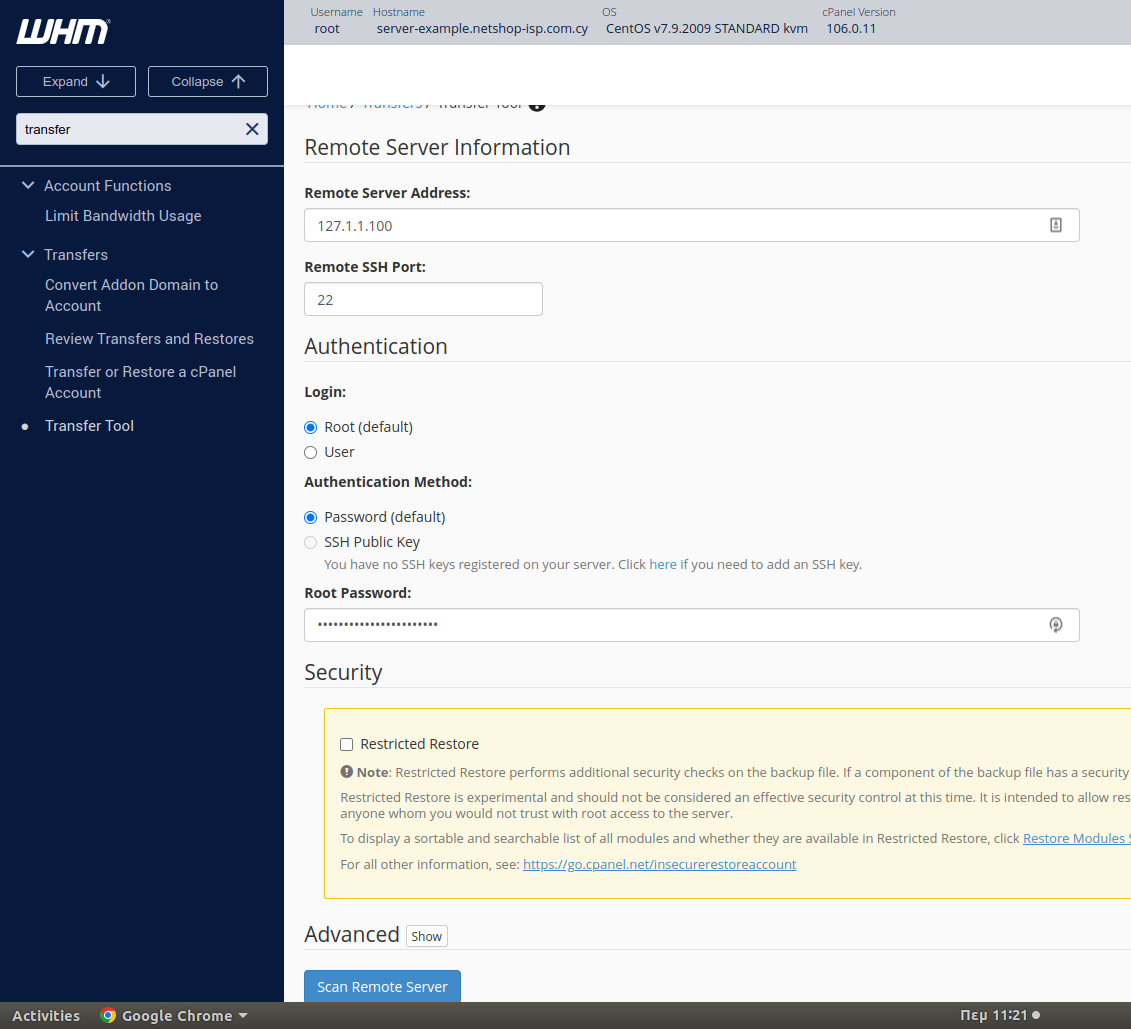
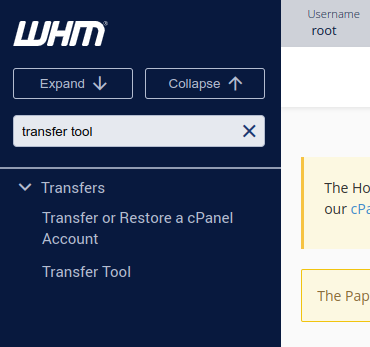
Then, from the left sidebar search for “Transfer Tool” and click it.

Access WHM Transfer Tool

Step 3 – Enter credentials for the remote Plesk server

Remote Server Address: Enter the IP address of the source server (Plesk)
Remote SSH Port: 22 (or your custom SSH port)
Login: Select root
Authentication Method: Select SSH, unless you have configured SSH keys on the source server
Root Password: Enter the root password for your Plesk server

Then, Click “Scan Remote Server” to view a list of all the accounts in Plesk.

Scan Remote Server – WHM Transfer Tool

Step 4 – Choose accounts to be migrated from Plesk to cPanel

The last step requires to choose the accounts you wish to transfer from Plesk to cPanel.

Check the box next to each Plesk account you wish to transfer to cPanel. Select Copy to start the data migration.

Once the transfer and restore completes, then you are all set! You can go to WHM >> Home >> Account Information >> List Accounts to view your migrated accounts.

NetShop ISP Signs as E-Invitation Sponsor of Fazzaco Hall of Fame Award Ceremony 2023

NetShop ISP, an award winning data center company, has been announced as the E-Invitation Sponsor of the Fazzaco Hall of Fame Award Ceremony 2023.

NetShop ISP, an award winning data center company, has been announced as the E-Invitation Sponsor of the Fazzaco Hall of Fame Award Ceremony 2023.

The awards ceremony is going to make debut at Crowne Plaza, Limassol, Cyprus on February 23rd, 2023, offering seamless networking and resource sharing opportunities for decision makers across the forex and fintech industries.

As per the organizer’s message, “Fazzaco Hall of Fame Award Ceremony 2023 is a must-attend networking event for executives, IBs, and experts in the financial and fintech industries seeking to expand business network. Kicking off with a red carpet walk exclusive to real world stars in the financial and fintech industries and featuring great speeches and deluxe dinner party (also networking time) in addition to awards presentation, it is designed to give attendees the most enjoyable and productive event experience”.

Read more information about the event here.

About NetShop ISP

Since 2004, NetShop ISP has been working on refining the conventional web & server hosting products. The company has introduced a truly innovative set of solutions affordable enough to kickstart a startup project and scalable to meet any software, hardware and traffic volume needs. More than 45 forex brokers have selected NetShop ISP for trading platforms hosting and disaster recovery solutions in 2022 only. 

How To Change Administrator Password on Windows Server 2022

In this tutorial we will demonstrate the steps with screenshots on how to change the Administrator password on Windows Server 2022.

The Administrator user is the account on Windows Server 2022 with the highest privileges. This means an Administrator can install/uninstall software, access all files/folders, and change security settings on the server.

In this tutorial we will demonstrate the steps with screenshots on how to change the Administrator password on Windows Server 2022.

5 Easy Steps to Change Administrator Password on Windows Server 2022

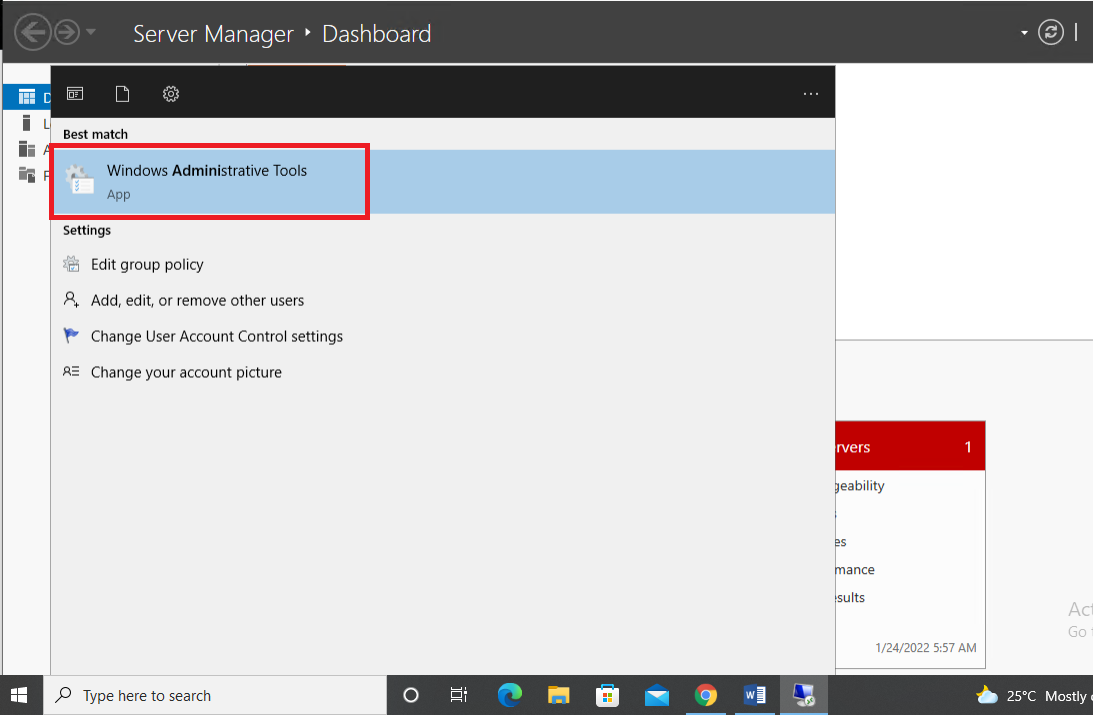
Step 1: Go to Start and search for Administrative Tools. Then click the associated result

Step 1 – Change Administrator Password on Windows Server 2022

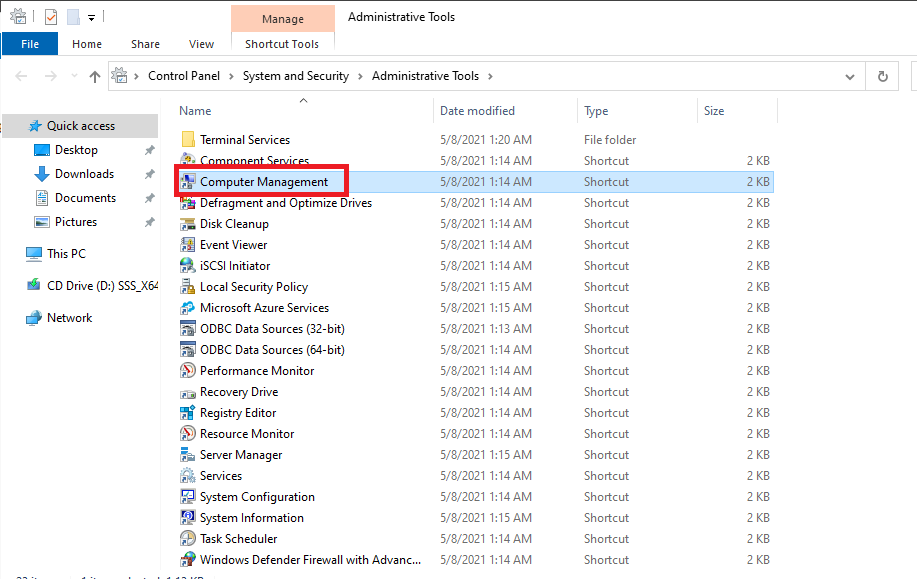
Step 2: Double-click on Computer Management as per the screenshot below

Step 2 – Change Administrator Password

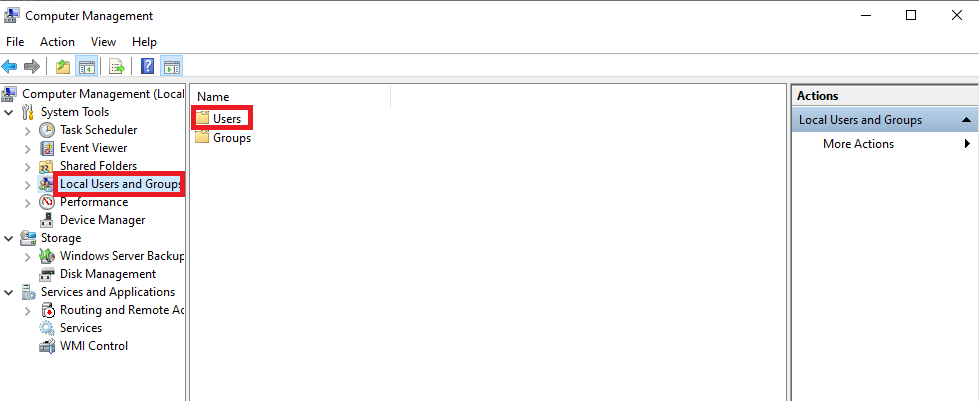
Step 3: Expand the Local Users and Groups from the left sidebar, and then choose Users option from the list

Step 3 – Change Administrator Password

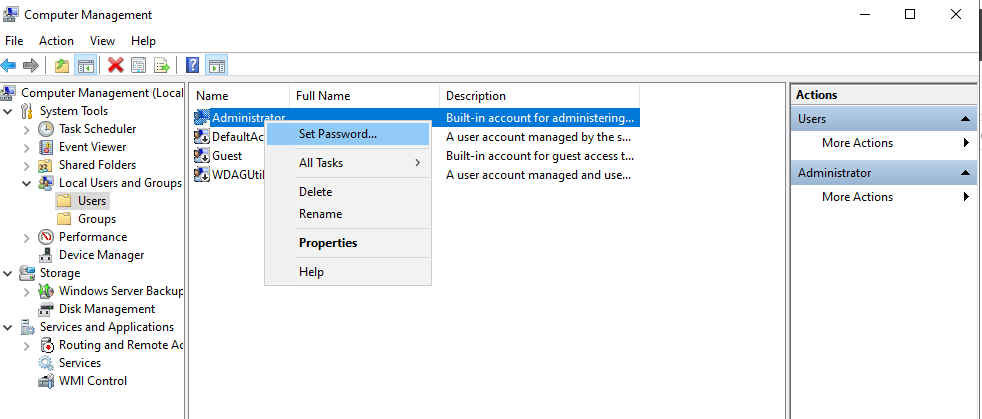
Step 4: Right-click on the Administrator option and click Set Password as shown below

Step 4 – Change Administrator Password

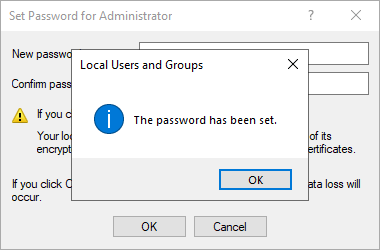
Step 5: Enter a new Administrator password and click OK

Step 4 – Change Administrator Password

You are all set! You have now successfully changed the password for Administrator account on Windows Server 2022.

Reflecting on a Year of Growth and Big Investment [CEO Interview at SBC Leaders Magazine]

Stefano Sordini, CEO at NetShop ISP, reflects on a year of big investments and major changes for the data center and server hosting provider in 2022. SBC Leaders Magazine Issue 24 (Jan 2023)

Updated 26 January 2023

Stefano Sordini, CEO at NetShop ISP, reflects on a year of big investments and major changes for the data center and server hosting provider in 2022. The following part of the interview has been originally published at sbcnews.co.uk (22 December 2022).

Download for free a digital copy of SBC Leaders Magazine Issue 24 (Jan 2023)

SBC: Stefano, we have seen a number of updates and product launches from NetShop ISP throughout 2022. Can you name the most important of them which relate to the hosting services offered to igaming companies?

Stefano Sordini: Yes, 2022 was a really busy and exciting year for us. We made some major investments and implemented key data-driven decisions that have proved to be very beneficial for our igaming clients.

We started out the year with the expansion of our Secure Private Network (SPN) in Europe, Asia and the United States, to effectively allow our customers to interact with their servers without the use of an additional VPN or secure tunnels.

In April we carried out a casino games audit for igaming software provider and game development company, Fugaso. The successful completion of such a complex technical evaluation was a great accomplishment for our team and the optimisation recommendations proved extremely valuable for Fugaso, allowing it to gauge its overall performance and implement the necessary technical suggestions.

Another major update in 2022 has been our expansion within Asia and South America with three new data centres. Our two new Asian locations are in Hong Kong and Tokyo, and our very first data centre in LatAm is located in São Paulo.

This year we also began providing hands-on support to our clients looking to obtain a Curaçao eGaming licence. The licensing process in Curaçao is known to be relatively straightforward in comparison to other jurisdictions, but a thorough understanding of the legal and regulatory requirements is crucial.

SBC: In terms of inquiries for hosting by gambling companies in 2022, has there been a booming jurisdiction this year? Which one was the most popular based on your existing customers’ preferences?

SS: We’ve most definitely seen an increase in inquiries for Curaçao hosting over the last year. As mentioned in the previous question, Curaçao is well-known for its straightforward gambling licence procedure, and remains as one of the most attractive jurisdictions for both established and start-up online gambling operators.

The affordability of obtaining a Curaçao Gaming licence, as well as the jurisdiction’s unique zero tax rate on all foreign-sourced revenue, makes entering the market extremely feasible. In addition to that, its ‘one-licence covers all’ approach makes diversification of offerings a lot simpler for operators in the long run.

Generally speaking, Curaçao has always been highly welcoming for online gambling operators, and we’ve noticed a peak in interest in 2022, which could also be down to the challenges faced by Malta during the year.

SBC: Online gambling is gaining more and more popularity in certain regions within Latin America and will continue to evolve over the next few years. How can NetShop ISP serve sportsbook and online casinos to establish a presence in the region?

SS: The sheer size of the LatAm market, growth data and future projections are what prompted our decision to move forward with deploying private network infrastructure in São Paulo, Brazil. The main service we offer here is bare metal dedicated servers which are ideal for sportsbook and online casinos seeking to solidify their presence in the region.

As well as a database server being required in the region for regulatory purposes, hosting your website on a dedicated server here is also recommended to guarantee faster access for users and low network latency with local game providers and data feeds in Brazil.

SBC: Out of all the Latin America regions, what has driven NetShop ISP to establish a data centre presence in Brazil specifically?

SS: Brazil is truly an up and coming igaming hotspot. It has a population of over 200 million, and a staggering 75% of that comprises internet users. Not to mention the country is known for having a huge passion for football, amongst other sports, with its national team being considered one of the greatest of all time. This, in itself, makes Brazil one of the biggest esports markets in the world, and thus extremely attractive for igaming operators.

SBC: In addition to NetShop ISP’s global infrastructure expansion, you also mentioned DDoS Attacks protection earlier. How is this related to your products/solutions offerings for igaming operators and suppliers?

SS: We offer protection against the most common amplification DDoS attacks by default, with no further reconfiguration required on the customer side. This is already included in billing plans at no additional cost. The filtering engine drops the malicious amplified packets, leaving the rest of the traffic intact. Some attacks covered by our solution are NTP amplification, DNS amplification, SSDP amplification and SNMP amplification, to name a few.

The mitigation is implemented completely on our network equipment and adds no latency to your packet round-trip time. In Amsterdam, we’ve got over 500 Gbps of bandwidth to implement that mitigation, and we could use upstream BGP flow spec rules.

SBC: Finally, please share any new exciting plans for 2023. Can we expect further expansion into new regions or any innovative solutions to be launched in the near future?

We’ve got some exciting plans in the works and are really looking forward to another great year at NetShop ISP. Of course, we are always working towards implementing innovative hosting solutions to cater to the bespoke needs of our igaming customers and partners. In terms of expanding into new regions, that is most definitely on the cards for 2023.

The full interview will feature in the next issue of SBC Leaders magazine at ICE in February.
How To Remove SSH Keys from Linux Server

This article provides an easy, step-by-step guide on how to remove/delete SSH keys from a linux server.

This article provides an easy, step-by-step guide on how to remove/delete SSH keys from a linux server.

Prerequisites

  • Steps in this article apply to Linux and BSD servers
  • You have one or more SSH Keys added on your server in OpenSSH format
  • You have ssh access on the server

Four Steps to Remove SSH Keys

  1. SSH to your server
    ssh <user>@<server ip>
  2. Edit file ~/.ssh/authorized_keys using your favorite editor (e.g. vi, nano, pico)
    vi ~/.ssh/authorized_keys
  3. Remove the line that corresponds to your key
  4. Save the file and exit (command below applies to ‘vi’ editor)
    Hit ‘Esc’ button, then type wq! and hit Enter

That’s it!

How To Assign SSH Key to your Linux VPS Server

Adding one or more SSH keys to your Linux VPS server can now be done easily, with the click of a button via myNetShop portal.

  • Login to https://my.netshop-isp.com.cy
  • Go to VPS management page
  • Click “SSH Keys” from the actions toolbar
  • Click “Add new SSH key” (or choose from existing)
  • Click on “Use SSH key” to assign your key to the VPS server

You can also refer to the article How To Enable SSH on Debian 11 Server if you wish to do the entire setup manually.

How To Install cPanel / WHM on Ubuntu 22.04 Server

In this article we demonstrate an easy, 4-step guide to install cPanel/WHM on Ubuntu 22.04 (LTS) Server.

cPanel is one of the world’s most popular control panels for Linux servers. Although it is not the cheapest option available out there, its user-friendly UI along with the huge variety of plugins and tools that come with cPanel/WHM, make it the best control panel software IT admins and webmasters prefer in 2023.

Although cPanel and WHM are two different portals, there is only one installation process that will deploy them both. Let’s see the main features of cPanel and WHM before proceeding to the rest of this tutorial.

cPanel Features

  • Domains / Addon Domains / Subdomains Management
  • E-mail accounts administration
  • Log files and Statistics
  • Database management
  • File Manager
  • SSL Certificates and other security settings
  • … and more

WHM Features

  • Server configuration and monitoring
  • Services fine tuning (mail, ftp, apache/nginx, php, etc)
  • Backup settings and Migration tool
  • 3rd-party plugins installation and management
  • Manage cPanel Own branding
  • Resellers management
  • … and more

Easy Guide to Install cPanel/WHM on Ubuntu 22.04 Server (4 Steps)

Let’s take a look on how you can install cPanel/WHM on Linux Ubuntu 22.04 (LTS) server in six (6) easy steps.

Step 1 – Disable firewalld and Update system

If you have an active firewall, disable and stop it prior installing cPanel. Upon completion of the installation you can re-enable it.

root@ubuntu22.04:~$ iptables-save > ~/firewall.rules
root@ubuntu22.04:~$ systemctl stop firewalld.service
root@ubuntu22.04:~$ systemctl disable firewalld.service

Then, update the server’s packages using the command below:

root@ubuntu22.04:~$ apt update && apt upgrade

Step 2 – Set Hostname (FQDN)

cPanel requires that the server is associated with a fully qualified domain name (fqdn) for the installation to begin and complete without errors.

Let’s say your desired hostname is cpanel.netshop-isp.com.cy and this sub-domain points to your server’s IP address, then we are going to set it on the server as follows:

root@ubuntu22.04:~$ vi /etc/hostname

When the hostname file opens delete any entries and enter your hostname cpanel.netshop-isp.com.cy. Then save and close the file.

Now, open /etc/hosts file and add the following entry (replace the IP with the real IP of your server):

192.168.1.1 cpanel.netshop-isp.com.cy cpanel

Once done, save and close the file.

Step 3 – Install cPanel/WHM

Once all the above steps are completed, you are now ready to download the official script and run it for the installation to begin.

root@ubuntu22.04:~$ cd /home && curl -o latest -L https://securedownloads.cpanel.net/latest && sh latest

If no errors come up, the installation should be finished in a couple of minutes.

Step 4 – Access WHM/cPanel GUI

You can now access your WHM GUI by typing the hostname or IP address on your browser, in any of the following ways:

https://[server-ip]:2087
https://[server-ip]/whm
https://fqdn-hostname/whm
https://fqdn-hostname:2087

Extra Step (if needed) – Activate License

cPanel licenses are IP-based, meaning that upon order of a cPanel license you need to enter the server’s IP so that it can automatically activate it once you install it on a server.

If you have a valid license purchased and you still see the message to “Purchase a License” or “Continue with Trial”, execute the following command on your server. The command will refresh the license activation over the internet.

root@ubuntu22.04:~$ /usr/local/cpanel/cpkeyclt

How To Install Language Pack on Windows Server 2019

In this article we will demonstrate an easy way to install a language pack on Windows server 2019 using an ISO file that contains multiple languages which you can choose from.

Installing additional languages on your Windows Server can be a laborious task and some times unsuccessful as various errors may come up during the process.

In this article we will demonstrate an easy way to install a language pack on Windows server 2019 using an ISO file that contains multiple languages which you can choose from.

Steps to Install Additional Languages on Windows Server 2019

Before proceeding to the remaining of this tutorial, please check that the following pre-requisites are satisfied:

Pre-requisites

  1. Windows Server 2019 edition installed (the steps may also work with 2016 and 2022 editions)
  2. Active internet connection on the server
  3. RDP access to the server with full Administrator account

Step 1 – Download ISO file

Open the Internet Explorer, Chrome or a browser of your choice on your Windows Server and navigate to this link to download the ISO containing multiple language packs.

Step 2 – Mount ISO

Once the ISO file is downloaded, you need to mount it so that it shows up as a DVD Drive. Most of the times the ISO is auto-mounted by double clicking the downloaded ISO File. If not, just right-click the file and click mount as shown in the screenshot below.

Step 3 – Copy language files locally on Server (faster method)

To expedite the installation of your additional language we recommend that you copy the language pack to the Desktop or any other folder on your Windows Server.

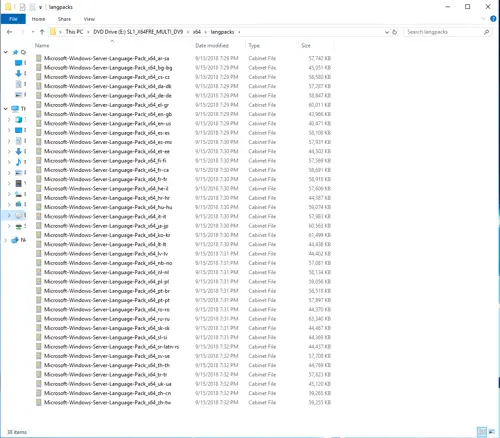
Go to DVD Drive’s contents and navigate to \x64\langpacks. Then Copy your language files and paste them to the folder of your choice.

Copy language pack file(s) locally for faster installation

Step 4 – Install Language(s) with LPKSetup.exe

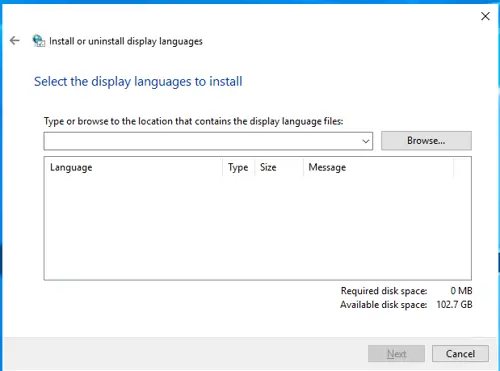
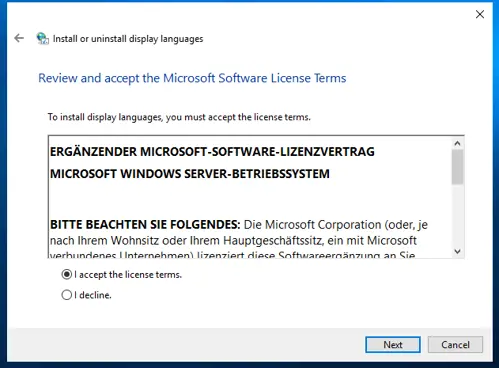
Go to Start menu, type lpksetup.exe and click on the result. This will open a new window for installing/uninstalling display languages as shown below.

Install language pack on Windows Server 2019

Click on “Install display languages”, then click “Browse” to choose the language packs you have copied from Step 3, and then click “Next”. Accept the Terms and the installation will begin.

Final step to start installing additional language pack on Windows Server 2019

This is it! You have now successfully installed additional language pack(s) on your Windows Server 2019. Enjoy!

Ultimate Fintech Awards 2023: NetShop ISP Shortlisted for “Best Connectivity Provider – MEA” Award

Leading Cyprus-based hosting company, NetShop ISP, has been shortlisted at the prestigious Ultimate Fintech Awards 2023 for “Best Connectivity Provider – MEA”.

Leading Cyprus-based hosting company, NetShop ISP, has been shortlisted at the prestigious Ultimate Fintech Awards 2023 for “Best Connectivity Provider – MEA”.

The UF Awards 2022 recognise top brands in the B2B & B2C online trading and fintech industries with the aim to provide traders and businesses with an industry benchmark of the best companies to trade and do business with.

NetShop ISP has been established in 2004, providing since then unparalleled infrastructure hosting and global connectivity services in Europe, Asia, Middle East and the Americas. With more than 100 Forex brokers as customers and numerous technology providers, NetShop ISP is among the most reliable and well-known suppliers in the Fintech industry.

“We are delighted to see NetShop ISP competing head-to-head with industry’s giants. The UF Awards nomination as Best Connectivity Provider, is the result of hard word and dedication to providing the best hosting and connectivity services to Forex brokers, Liquidity providers and other technology firms in the fintech sphere”, said Stefano Sordini, CEO at NetShop ISP.

The results of Ultimate Fintech Awards 2023 will be announced on the 18th of January 2023.

Vote for NetShop ISP at UF Awards 2023 “Best Connectivity Provider – MEA” here.

Updated Version of myNetShop Client Portal Released: What’s New

NetShop ISP, a leading web hosting provider based in Cyprus, announces, today, a major release update of the myNetShop client portal. The new release features an updated and highly sophisticated engine, as well as a new, intuitive design interface for both desktop and mobile devices.

NetShop ISP, a leading web hosting provider based in Cyprus, announces, today, a major release update of the myNetShop client portal.

The year 2022 has seen an accelerated uptake of hosting services and digital products, as well as a remarkable increase in the time an average customer spends daily in the portal. Comparing to the previous year, in 2022 there has been a 43% growth in the number of customers who are using myNetShop on a daily basis, as well as a notable 31% increase in the number of API calls per minute for activities such as DNS management, OS re-build for VPS, Password reset on Dedicated Servers, and remote deployments of Forex VPS servers.

The new release features an updated and highly sophisticated engine, as well as a new, intuitive design interface for both desktop and mobile devices.

myNetShop Engine New Features

Some of the new features introduced in this version are:

  1. Backup/snapshots creation and management for VPS servers
  2. Multi-factor Authentication (MFA)
  3. Real-time inventory check for Dedicated Servers (in/out of stock)
  4. Revolut added in list of accepted payment methods
  5. USDT (Tether) added in list of accepted payment cryptocurrencies
  6. Quote Estimates now visible to customers with ability to approve or reject
  7. Clients can now Invite Users (other myNetShop registered clients) to view information on their Account
  8. Option to send encrypted message via ticket for sensitive data exchange
  9. “Emergency Button” available for customers subscribed to Premium SLA and/or Managed Services

In addition to the new functionality enhancements, there have been important UI changes to enhance the user experience – from signup to product ordering, payment and service management.

New User Interface

The new UI is a result of an in-depth analysis of the users activity throughout the years and their engagement with the tools to order or manage their services.

Here are the most important changes one can see in the updated myNetShop portal interface:

  1. Left Sidebar Menu – all offered hosting services are visible by default, with navigation to order or manage in one click
  2. Top Menu – quick access to important tools such as Support, Invoices, Notifications and User Menu
  3. Accessibility – improved contrast between background and foreground elements, as well as navigation improvements from mobile devices
  4. Dashboard – New, widget-based interface design.
  5. Single Management Page per Product Category – Easier navigation to a product category’s management page. Different products (e.g. Cyprus VPS, UK VPS, Singapore VPS) can now be viewed and managed from a single category page (e.g. Virtual Servers)

“I am honored to be leading NetShop ISP, a hosting company of choice for more than 3,000 customers worldwide. We are committed to building out the myNetShop portal as a hub for centralized and efficient administration of all services used by our customers; from website hosting, domain names and backups, to cloud, dedicated servers and co-location hosting. Stay tuned for many new myNetShop features scheduled to roll out within Q1 and Q2 2023”, said Stefano Sordini, CEO at NetShop ISP.

Stefano Sordini, CEO at NetShop ISP, comments on new myNetShop Portal release

“I am honored to be leading NetShop ISP, a hosting company of choice for more than 3,000 customers worldwide. We are committed to building out the myNetShop portal as a hub for centralized and efficient administration of all services used by our customers; from website hosting, domain names and backups, to cloud, dedicated servers and co-location hosting. Stay tuned for many new myNetShop features scheduled to roll out within Q1 and Q2 2023”, said Stefano Sordini, CEO at NetShop ISP.

How To Change RDP Port on Windows Server 2016/2019/2022

In this article we will explain how to change the RDP Port on Windows Server 2016/2019/2022 via regedit and then make the necessary changes on Windows Firewall for allowing inbound connections to the new RDP port.

The remote accessibility of a Windows server is managed by the Remote Desktop Services (given it’s enabled) which “listens” to port 3389 and its open by default. Whilst this is an essential communication protocol for establishing connection to remote Windows machines, it is often used by hackers to deliver a ransomware or a DDoS attack to a single server or a distributed network of inter-connected machines.

One of the best security practices we follow when setting up Windows Servers is to change the default RDP port ‘3389’ to a custom, non-standard port. Have in mind that ports ranging from 1 to 1023 are called known or standard ports, while ports 49152-65535 are dynamic/non-standard. You are free to use any ports from the dynamic range but not one from the known/standard range as the latter may be in use by another Windows service.

In this article we will explain how to change the RDP Port on Windows Server 2016/2019/2022 via regedit and then make the necessary changes on Windows Firewall for allowing inbound connections to the new RDP port.

How To Change RDP Port on a Windows Server

Pre-requisites

  • Tutorial steps can be applied (tested) on Windows Server 2012 R2, Windows Server 2016, Windows Server 2019 and Windows Server 2022
  • Access on Windows Server using Administrator or any other user with admin privileges
  • Out-of-band access on the server such as iDRAC or iLO – useful in case you lose remote connection to the server over the public network

Steps to Change RDP Port from Registry (regedit)

  1. Type regedit in the Search box
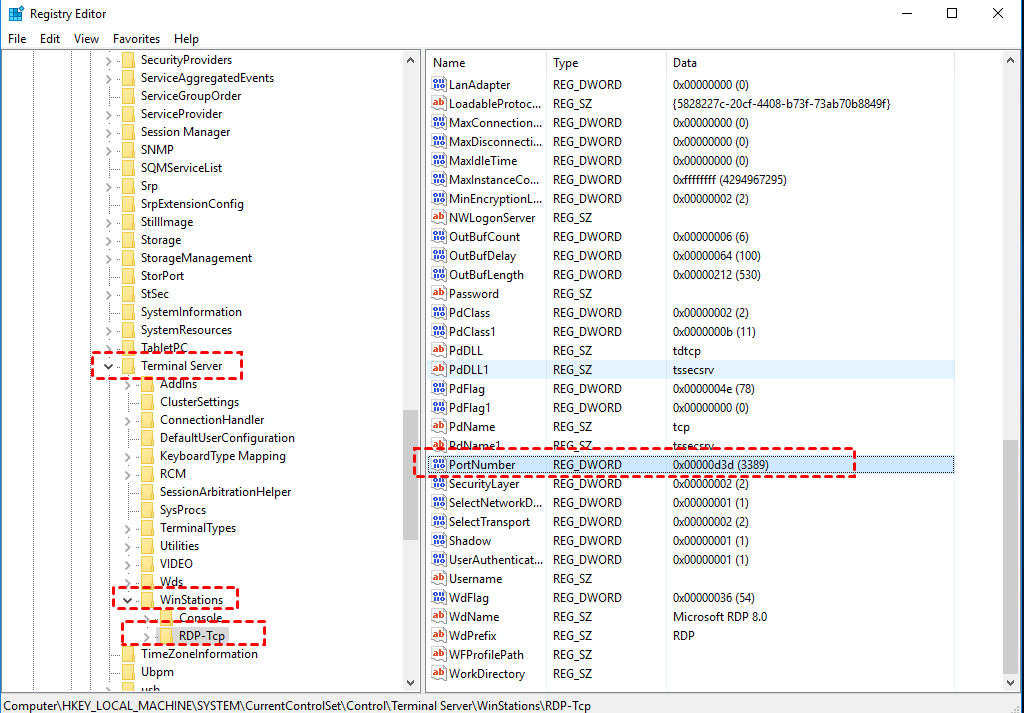
  2. From the left navigation bar follow this path: HKEY_LOCAL_MACHINE\System\CurrentControlSet\Control\Terminal Server\WinStations\RDP-Tcp
  3. Find PortNumber
  4. Right-click Edit, then click Modify, and then click Decimal
  5. Type your new desired port number, and then click OK.
  6. Close the registry editor and restart your server*

* Proceed with server restart only if you are sure there is no Firewall on your server. In any other case, read further below how to whitelist the new RDP port on Windows Firewall.

Change RDP Port on Windows Server from regedit

Allow Custom RDP Port on Windows Firewall

Depending on your Windows Firewall state, you may need to add the new RDP port in the Inbound rules to ensure new connections will be allowed.

  1. Open Windows Firewall on your Server (type firewall in the Search box)
  2. From the left-hand navigation, click Inbound Rules
  3. Click New Rule in the right-hand pane to open the New Inbound Rule Wizard.
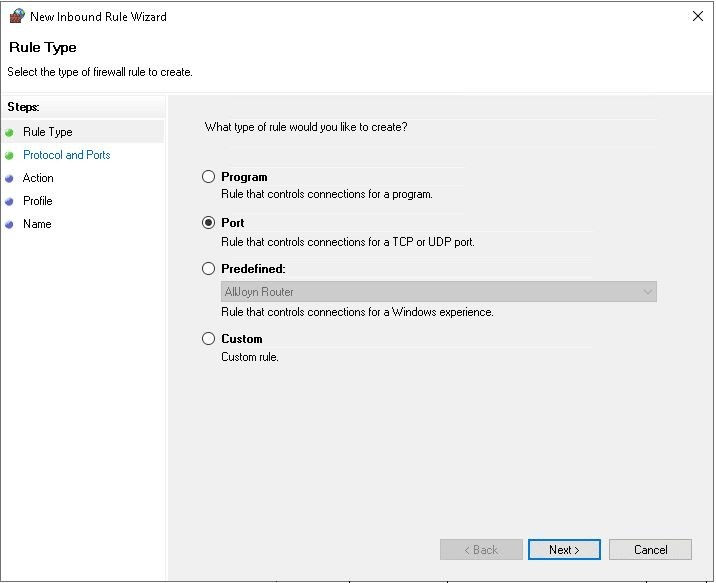
  4. In the New Inbound Rule Wizard, under the Rule Type section, select Port and click Next
  5. In the Protocol and Ports section, select TCP. Next, select Specific local ports, enter the custom RDP port as you have set it in Registry and then click Next
  6. In the Action section, select Allow the connection and click Next
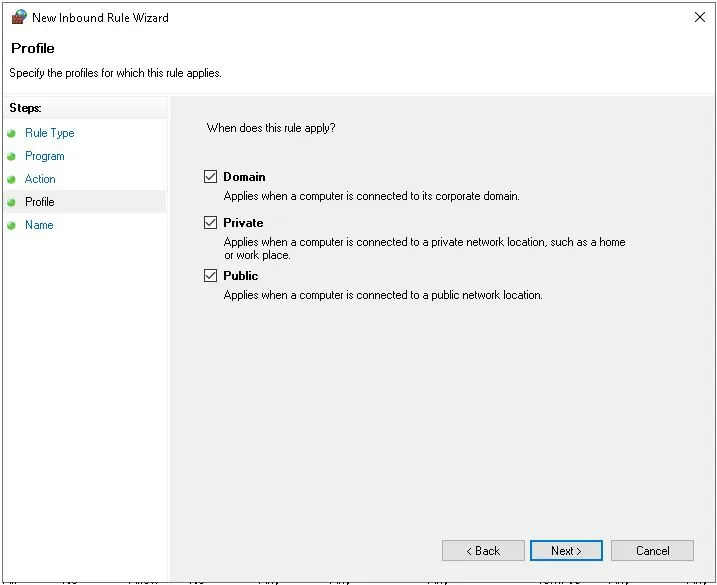
  7. In the Profile section, select all appropriate profiles for when this rule applies and click Next
  8. Finally, give your new rule a descriptive name so that it is easy to find later, and click Finish.
  9. Reboot your server if you haven’t done so after the registry changes
Allow new RDP Port on Windows Server Firewall
Create Inbound Firewall Rule for new Windows RDP Port

Verify New RDP Port with PowerShell

Once your server has been rebooted you should be able to access it with the newly added RDP Port. To verify the newly set RDP port number, open PowerShell and run the following command:

Get-ItemProperty -Path 'HKLM:\SYSTEM\CurrentControlSet\Control\Terminal Server\WinStations\RDP-Tcp' -name "PortNumber"

Sample Output:

PortNumber : 61489
PSPath : Microsoft.PowerShell.Core\Registry::HKEY_LOCAL_MACHINE\SYSTEM\CurrentControlSet\Control\Terminal Server\WinStations\RDP-Tcp
PSParentPath : Microsoft.PowerShell.Core\Registry::HKEY_LOCAL_MACHINE\SYSTEM\CurrentControlSet\Control\Terminal Server\WinStations
PSChildName : RDP-Tcp
PSDrive : HKLM
PSProvider : Microsoft.PowerShell.Core\Registry

This is it! You have successfully changed your Windows Server’s Remote Desktop Port and allowed it through your Windows Firewall.

AlmaLinux 9.0 Stable Now Available for Deployment on Cloud VPS and Dedicated Servers

The AlmaLinux project became the first public RHEL-based distribution that has released a stable build based on RHEL 9. Deploy AlmaLinux 9 Stable on VPS and Dedicated Servers.

The AlmaLinux project became the first public RHEL-based distribution that has released a stable build based on RHEL 9. This new distribution is fully binary compatible with Red Hat Enterprise Linux which means you can use it as a replacement for RHEL 9 and CentOS 9 Stream.

New Features and Changes in AlmaLinux 9

There are quite a lot of exciting features introduced by the AlmaLinux project. Here are the best six features we have pinned down and sharing with you.

GNOME 40 and GTK 4 Library

The desktop edition of AlmaLinux 9 is based on GNOME 40 and the GTK 4 library. A noticeable change one can notice is the virtual desktops in Activity Summary mode that have been changed to landscape orientation and are displayed as a continuous scrolling chain from left to right.

GRUB Boot Menu

By default, GRUB boot menu is hidden if it is the only distro installed on the system and if the last boot was successful. To display the menu during boot, simply hold down the Shift key or the Esc or F8 key several times.

OpenSSL and OpenSSH Updates

Security updates could not have been neglected, of course. AlmaLinux 9 distribution now uses a new branch of the OpenSSL 3.0 cryptographic library, which means more secure cryptographic algorithms are in enabled.

Additionally, the OpenSSH package has been updated to version 8.6p1 and Cyrus SASL was moved to the GDBM backend instead of Berkeley DB. The NSS (Network Security Services) libraries no longer support the DBM (Berkeley DB) format and, finally, GnuTLS has been updated to version 3.7.2.

Python 3

AlmaLinux 9 is now fully migrated to Python 3 with default branch set to Python 3.9. Python 2 has been deprecated.

SELinux

SELinux performance has been significantly improved with reduced memory consumption, as there is now support for setting “SELINUX=disabled” to disable SELinux in /etc/selinux/config has been removed (the specified setting now only disables policy loading, and in fact disabling SELinux functionality now requires passing “selinux=0” to the kernel).

Deploy AlmaLinux 9 on VPS and Dedicated Servers

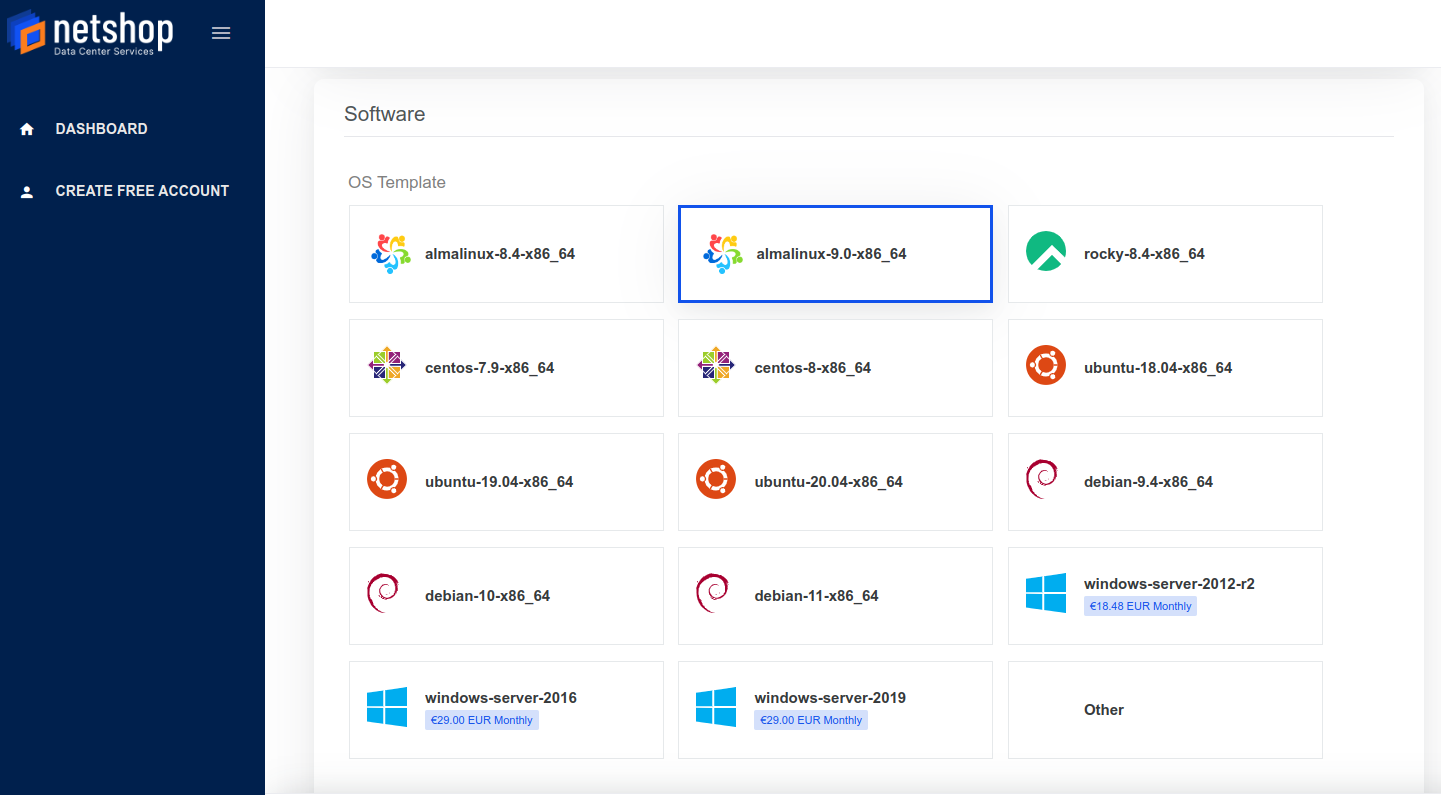
The stable edition of AlmaLinux 9 is now available for deployment in all our VPS plans.

Deployment is instant and all you have to do is choose your favourite VPS plan, choose AlmaLinux 9 and proceed with order.

Deploy AlmaLinux 9 Stable on VPS Server

Similarly, you can choose AlmaLinux 9 from the Operating system drop-down list when ordering a Dedicated server of your choice.