NetShop ISP Announced as Sponsor of Cyprus Forum 2022
NetShop ISP is delighted to be announced as a sponsor for the Cyprus Forum 2022 – Nicosia (Cyprus) Municipal Theatre on the 29th and 30th September 2022
NetShop ISP is delighted to be announced as a sponsor for the Cyprus Forum 2022. The conference, which will take place at the Nicosia Municipal Theatre on the 29th and 30th September 2022, promotes constructive dialogue that will ultimately result in solutions to public policy issues.
Organised by Oxygono, and in association with the Delphi Economic Forum and Zenox Public Affairs, the Cyprus Forum has made it their mission to improve sustainable and socially responsible policy in Cyprus as well as the wider Eastern Mediterranean region. The forum is an opportunity for people from all backgrounds to exchange ideas and find creative ways to promote change in different areas of our society.
NetShop ISP’s CEO, Stefano Sordini, comments “We’re really pleased to be sponsoring the Cyprus Forum this year. Through open discussion, a solution-oriented approach and accountability after the fact, we have seen the Cyprus Forum bridge the gap between policy makers and citizens to spark change, and that’s something we’re excited to be a part of.”
In attendance at the conference will be local and foreign political leaders as well as prominent figures from both the public and private sector, and a panel of selected speakers who will touch upon topics such as the economy, entrepreneurship and corporate responsibility as well as innovation and infrastructure.
How To Create New Users with Root Access and Without Sudo on Linux
In this guide, we explain how to create new users with root access but no ability for sudo. For the purposes of this tutorial we have tested all commands/steps on CentOS 7 and AlmaLinux 8 servers.
In this guide, we will tackle a common task system administrators face when managing users and permissions on Linux servers environment. For the purposes of this tutorial we have tested all commands/steps on CentOS 7 and AlmaLinux 8 servers.
The sudo command allows users to run programs and access privileged directories but it can also allow the sudo user to login as root. This is a problem as there is no efficient activity logging for each sudo user, i.e. they can all run commands that show up as the ‘root’ user.
The first three steps in this tutorial will demonstrate how to create a user with root-equivalent privileges. Then we will show you how to disable the user from sudo-ing as root.
Step 1 – Create new user account
Create a new user account using the useradd command:
useradd johny
Now set the user ‘johny’ a password with the passwd command:
passwd johny
Once you hit enter, you will be prompted to confirm the password. Make sure you use a strong password.
Changing password for user johny.
New password:
Retype new password:
passwd: all authentication tokens updated successfully.
Step 2 – Grant new user with sudo/root privileges
We are going to use the usermod command to add user ‘johny’ to the ‘wheel’ group. By default on RHEL/CentOS systems, members of the group ‘wheel’ are granted with sudo access.
usermod -aG wheel johny
At this point, user ‘johny’ has been added in wheel group without any restrictions. User johny can, at any time, run the command su root or sudo su to switch as the root user. If you want every user to run sudo-privileged commands under his/her own account (for logging purposes), then follow the last step below.
Step 3 – Modify Sudoers file
First, backup the /etc/sudoers config file as follows:
cp /etc/sudoers /root/sudoers.orig
Now, edit the sudoers config file as follows:
visudo
or
vi /etc/sudoers
Find this line: %wheel ALL=(ALL) ALL
Replace it with: %wheel ALL=(ALL:ALL) ALL, !/bin/su
Save the file and you are done!
Last Step – Verify
To verify if you have correctly disabled the sudo access to the user(s), login to your server as root and then switch to your user, let’s say johny
[root@netshop-server-demo ~]# su johny [johny@netshop-demo-server root]$
Now, as user johny try to sudo as root in 2 ways:
[johny@netshop-server-demo root]$ sudo su
Sorry, user johny is not allowed to execute '/bin/su' as root on netshop-server-demo.
[johny@netshop-server-demo root]$ su root
Password:
su: Authentication failure
[johny@netshop-server-demo root]$
Hooray! You are done!
How to Choose the Right Server for MT4 and MT5 Trading Platforms
In this article we will compare the MT4 and MT5 trading platforms and outline the necessary server and hardware requirements for hosting both.
As the middleman between traders and the market, the success of any Forex Brokerage business is dependent on the sophistication of its server infrastructure and systems. With that being said, when it comes to choosing the right server to host either MT4 or MT5 platforms, it is crucial for Forex Brokers to meet certain specification requirements in order to provide traders a powerful service.
In this article we will compare MT4 and MT5 platforms and outline the necessary server requirements for hosting both.
What is MT4
Developed by MetaQuotes and released in 2005, MetaTrader4 (MT4) is an online trading platform used primarily for Forex trading. Its versatility, simple user interface and customizability have made it one of the most popular online trading platforms, predominantly used for automated trading.
MT4 has become an integral component for many traders, especially for utilizing expert advisors (EAs) and technical advisors, which are readily available to purchase for traders without programming skills. Overall, the platform is extremely reliable and intuitive for both experienced and novice traders, and available across multiple devices.
What is MT5
Launched by MetaQuotes in 2010, MetaTrader5 (MT5) is a multi-asset platform used for Forex trading as well as Stocks and Futures. As MT5 was designed for trading beyond just Forex, it can connect to these centralized exchanges. The platform gives traders access to technical analysis tools, automated trading and copy trading, and is often preferred by experienced traders who trade multiple types of assets.
MT4 vs. MT5: Comparison of Features
Choosing between MT4 and MT5 is a lot more than just weighing up pros and cons. A common misconception is that MT5 is an updated version of MT4, but that’s just not the case. MT4 was designed specifically for Forex traders, whilst MT5 has broader applications for stocks, CFD and future trading, as well as Forex. Traders deciding between the two platforms should first consider their overall trading goals and whether they want access to markets beyond Forex.
Both platforms use their own custom programming languages, MQL4 and MQL5, each providing different capabilities and trading customizations. It can be said that MT4 is preferred by beginner traders due to its simplicity, with nine different time frames to choose from for chart analysis, compared to MT5’s 21 time frames that would be crucial for more experienced traders.
In addition to that, MT4 offers only four basic order types providing the ability to buy stop, sell stop, buy limit, and sell limit orders. MT5 provides those 4 as well as buy stop limit and sell stop limit orders, which are frequently used by seasoned traders and ultimately offer greater flexibility.
Trading Server Requirements
It is recommended to install both MT4 and MT5 on dedicated servers; more specifically two dedicated servers each located in different data centers. One to be used as the main server and the other as backup, with all data from the main server being backed up in real time. The backup server should be configured similarly, if not identically, to the main server.
Trading Server Requirements for MT4
Server requirements for MetaTrader 4 are as follows:
Minimum Requirements
Recommended Requirements
CPU
Intel i7 4th Gen Quad Core
Intel Xeon Quad Core E3 or E5
RAM
8 GB
16 GB
HDD
2 x 1 TB HDD (RAID 1)
2 x 480 GB SSD (RAID 1) for Trade and History server2 x 1 TB HDD (RAID 1) for backup servers
Network
100Mbps Internet connection for both download and upload
1Gbps Internet connection for both download and upload
Operating System
Windows Server 2016 Standard 64-bit
Windows Server 2019 Standard 64-bit
Minimum & Recommended Server Hardware requirements for Metaquotes MT4 Platform
Trading Server Requirements for MT5
Server requirements for MetaTrader 5 are as follows:
Minimum Requirements
Recommended Requirements
CPU
Intel i7 4th Gen Quad Core
Intel Xeon Quad Core E3 or E5
RAM
8 GB
16 GB
HDD
2 x 1 TB HDD (RAID 1)
2 x 480 GB SSD (RAID 1) for Trade and History server2 x 1 TB HDD (RAID 1) for backup servers
Network
100Mbps Internet connection for both download and upload
1Gbps Internet connection for both download and upload
Operating System
Windows Server 2016 Standard 64-bit
Windows Server 2019 Standard 64-bit
Minimum & Recommended Server Hardware requirements for Metaquotes MT5 Platform
Managed MT4 & MT5 Server Hosting with NetShop ISP
NetShop ISP is a multi-award winning Data Center Services and Hosting Provider with global infrastructure that spans across Europe, Asia Pacific and the United States. Our data centers are located in major financial hubs, and ensure reliable and secure hosting for MT4 and MT5.
With over a decade of industry experience, our team is on hand to answer your questions.
Copyrights: MT4 and MT5 software are intellectual property of MetaQuotes Ltd.
How To Achieve Ultra-Low Latency for Online Casino and Sports Betting platforms
technologies in order to support multiple integrated systems and ensure a high-speed transfer of data from/to the end-users (players).
One of the greatest challenges iGaming operators and Suppliers (data/media) face is to ensure that players receive the best possible user experience (UX). Imagine an online casino player interacting with the platform and just as the host is about to spin the roulette wheel, the game disconnects. In the case of a sports book platform, there is nothing worse than trying to bet on a live game and suddenly the video freezes.
According to Grandview Research, the online casino market will grow from $54B in 2019 with a CAGR of 11.5% in the period 2020 – 2027. As per a previous article published in our Blog, we highlighted that “the developments in technology and online security have made online gambling one of the fastest growing industries, with Europe becoming the biggest gambling hub in the world”.
The major challenges for an Online Casino or a Sportsbook platform are:
How to stream uninterrupted content to players located around the world
Exchange data between the player (end user), the operator (online casino / betting website) and the Supplier (data feeder, live dealer studio, etc)
Handle financial transactions in real-time
The common factor which is tightly related to all the above challenges is latency. Latency, in simple words, is the time it takes for data to “travel” from one point on a network to another. For example, a live dealer studio in Armenia streams video for an Online casino company with a Server hosted in Malta and players interacting from Europe or anywhere in the world. The data, video in this case, will travel from Armenia -> Malta -> rest of the world.
Addressing Challenges and achieving ultra Low Latency
Any live streaming platform, whether that is an online casino or a betting platform, requires to adopt high-end technologies in order to support multiple integrated systems and ensure a high-speed transfer of data from/to the end-users (players).
WebRTC is a high-end technology which accommodates fast multimedia transfer from source to destination, and is fully compatible with all types of mobile devices.
In addition to the software technologies an iGaming operator and supplier must utilize, great attention must be given to the Infrastructure side of things in order to achieve ultra low latency and deliver the best user experience to the casino or betting players.
In terms of Network infrastructure for ultra low latency we have identified the following 3 key points that your technology partner, i.e. hosting provider, must offer:
1. Dedicated Network Speed & Flexible Bandwidth
The interaction of each player with the casino or betting software is handled by an application/front-end web server. No matter how fast the media content is delivered by the supplier to you, the players uninterrupted activity is dependent on your servers’ network speed and bandwidth.
Dedicated network speed guarantees that your server is entitled to a specific speed for downloading and uploading data. Whilst this option may be more expensive than of a shared network speed, it is essential in order to accommodate fast transmission of large media types, i.e. video streaming, to your players.
Flexible Bandwidth plays also a key role in improving your Users’ experience. Simply put, you don’t want to be capped once your servers have reached the allocated amount of monthly traffic. It is common in the igaming sector, that a server will utilize low bandwidth during weekdays, and large spikes on weekends. Therefore, it is important that your hosting provider can offer uncapped or unmetered bandwidth to your hosted infrastructure.
2. Global CDN
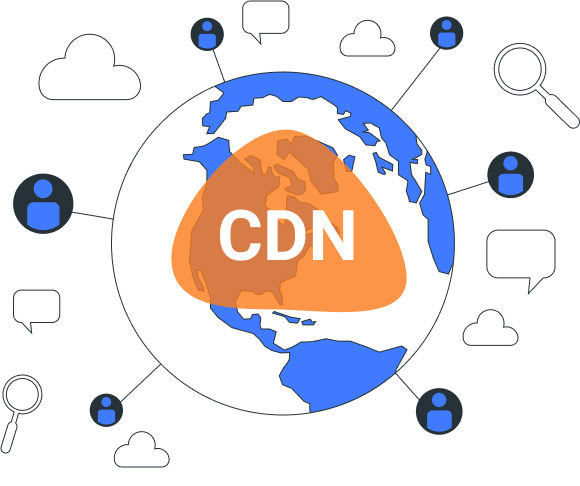
Adopting a CDN (Content Delivery Network) for your igaming platform is essential.
As per a previous article we published, “CDNbasically store a replicated, or cached, version of website content in multiple points of presence (PoPs) all around the world, so that users can access it from the PoP that is located within the closest proximity to them”.
When we talk about servers in iGaming sector, regulatory compliance may be affecting your choice of where to host your infrastructure. For example, an online casino business granted with an MGA license in Malta and operates a live dealer studio in Armenia. As per the current regulatory framework, by the time of writing this article, the MGA licensee is allowed to host the infrastructure in any European Datacenter, as long as a replication database is hosted in Malta.
The best scenario proposed, given the above case study, is the following:
Primary infrastructure Location: Amsterdam, Netherlands (high-speed internet at low cost) Network Speed: 10 Gbps with metered Bandwidth Server Roles: Application / Web Servers / Database DDoS protection Included/Free
Replication infrastructure Location: Malta (regulatory compliant) Network Speed: 50 Mbps Server Roles: Database Replication / Backup
Summary
It is clear now that the latency aspect of an online business is king. High latency will kill your traffic, eventually, as users, nowadays, cannot afford high waiting time for a website to load or a financial transaction to be processed. On the other hands, low latency will strengthen the user’s experience on your platform and will positively impact your website’s SEO ranking.
If you are considering start an online gambling business, or if you wish to grow traffic and revenue for your existing gambling website, speak to one of our igaming experts today to arrange a meeting in-person or online.
How to integrate one of the most popular online casino games providers in Cyprus
If you are interested in integrating Pragmatic Play into your online gaming platform, there are a couple of things to do in order for you to achieve that.
In the world of iGaming there is one provider’s name that stands out among the rest, and that name is Pragmatic Play. Launched in 2015, company was a relatively young provider, but that hasn’t stopped the company from making its mark in the online gaming world after being licensed by the Malta Gaming Authority, GLI, National Gambling Office of Romania, the British licensing commission and other relevant bodies, Pragmatic Play rapidly grew in popularity, and quickly became a user and online casino favorite, providing games for online casinos around the world.
How Pragmatic Play Stands Out in the iGaming Market
Today Pragmatic Play has more than 200 games, with new titles released every week, several prestigious awards, including 2 EGR B2B awards 2017-2018, Malta gaming awards 2018, WhichBingo Awards 2020, Ask Gamblers Awards 2020, and has also been reckoned as one of the most innovative, passion-driven and future based providers in the industry. The provider is also known for its top-notch 24/7 customer service, latest software tools, and the versatility of its games, making them available on all platforms, computer or mobile.
Features of Pragmatic Play Games
The features that make the games of Pragmatic Play so attractive to users and online casinos is that the games are developed by HTML5, making them playable on all platforms; the games are also available in 31 languages and support several currencies. The themes present in Pragmatic Play games are colorful, vibrant, and unique, and they provide an immersive experience for the player. With the first-class API systems available provider games can easily be integrated into your online casino website. Also, the games can also be easily customized to the players or the online casino preferences due to the Pragmatic Play array of special software called ‘Enhance.” With the help of this tool you can easily integrate in a very short time. It is possible to also create tournaments and events with fully customizable features.
Some of the top games include popular slots like three kingdoms, fruit party, wolf gold sweet bonanza, hot safari, Scarab Queen, Bee land, and the John Hunter Pragmatic Play also hosts online bingo, some other virtual sports items, and a live event such as baccarat, blackjack, roulette games that usually streamed.
How to Integrate Pragmatic Play Into Your Gaming Platform
If you are interested in integrating Pragmatic Play into your online platform, there are a couple of things to do in order for you to achieve that.
Optimize your platform
Before you can look for a suitable Game provider, your site has to be top-notch for it to be able to support the API necessary for the games; it also has to be responsive and dynamic, and easy to navigate. The website’s appearance should be colorful and vibrant so that it would be able to excite the player into playing the games available. The website menu section also has to be well developed and segmented for ease of access when the player decides to play a particular type of game. There is also the issue of security, and your website security system must be well integrated in order to avoid fraud and other financial crimes. Your website must also be able to support multilingual settings, currencies, and a robust payment system.
Make Research
Before you integrate the game provider software, you should do some research on online gambling and gambling places in the region that you are in. This includes things like knowing what aspects of online betting games are legal in your operation, getting the necessary licenses, and studying the behavior of your target market, then deciding on what games to integrate into your site.
Integrate the games and features of your choice using API
Now that your site is ready and your knowledge is fairly adequate, you can head over to Pragmatic Play and integrate the games that you want; game provider also makes it easy for you to customize your games, using the set of tools called Enhance and your preferred features and language should be running within few days. There is also a bonus section available where you can select bonus packages that you can use to attract new customers.
Integration of the Pragmatic Play Provider with NuxGame
In a latest update, leading betting software provider, NuxGame has added Pragmatic Play to its list of Game Providers which tells us that to integrate this game provider, you should contact NuxGame. Pragmatic Play has been a top game provider in recent years with its innovative methods and versatility. The addition of games would increase the variety of games a user can play without getting bored.
Curacao Government to form a new Online Gambling licensing body
In an effort to overhaul the island’s online gambling regulation, the Curacao Council of Ministers have recently approved a new bill that will see the formation of a new independent gambling regulator, the Curaçao Gaming Authority (CGA).Cur
Known for its relatively low barriers to entry and liberal gambling landscape, Curacao is set to completely reform its licensing regime in a bid to tackle illegal gambling.
In an effort to overhaul the island’s online gambling regulation, the Curacao Council of Ministers have recently approved a new bill that will see the formation of a new independent gambling regulator, the Curaçao Gaming Authority (CGA).
As it currently stands, there are four businesses licensed by the government, who in turn issue sub-licenses on their own terms. The new system will replace master license holders, effectively allowing the Curacao Government to regain power in terms of licensing and regulatory enforcement.
The CGA will be tasked with issuing licenses to both B2C operators and B2B suppliers, as well as ensuring that already licensed operators comply with the new rules set forth. In an attempt to increase revenue from the igaming sector, all licenses will also come with fees. Fees for the licences are anticipated to be around €4,000 to apply and then €12,000 annually, plus a monthly regulatory fee of €250 per URL.
The Curacao government has already begun registering existing sub-licensees into the new system, and those eligible will then have 12 months to convert their sub-licenses into transitional licences. Amongst the new measures that licensees will have to adhere to, which include stricter AML measures, is also the requirement of a minimum of three employees in key positions to be based on the island itself.
It is also anticipated that the CGA may also enter into cooperation agreements with other regulatory bodies, with such agreements being commonplace in Europe to prevent operators from targeting certain jurisdictions.
Curacao’s Finance Minister, Javier Silvania, has previously stated that the country currently does not make a lot of money from operators, with the majority of profits going directly to the master license holders. It is considered that the establishment of the CGA will enhance the legitimacy of the market, as well as profit and contribution to taxes.
With the bill already being given the go ahead by the Council of Ministers, it will be passed to advisory bodies for consultation before the final draft is put to Parliament, which is expected to be by the end of the year. Any significant changes to the bill have been deemed highly unlikely.
How To Connect to your Linux Server via myNetShop Web Console
In this tutorial we will explain the easiest way to connect to your Linux server using the Web Console available in the myNetShop portal. Our web console utilizes the wss protocol for better security and stability of the connection to your server.
Go to https://my.netshop-isp.com.cy and use your registered e-mail and password to login.
Step 2 – Go to your Server management page
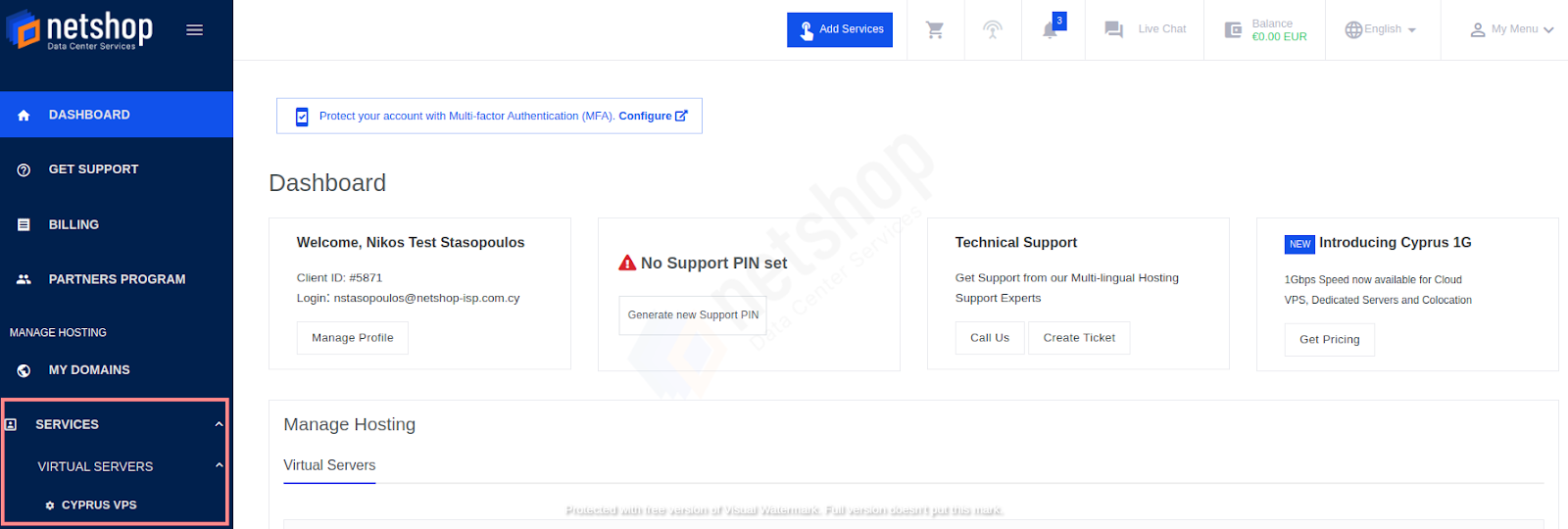
From the left navigation menu to go to Services > Virtual Servers
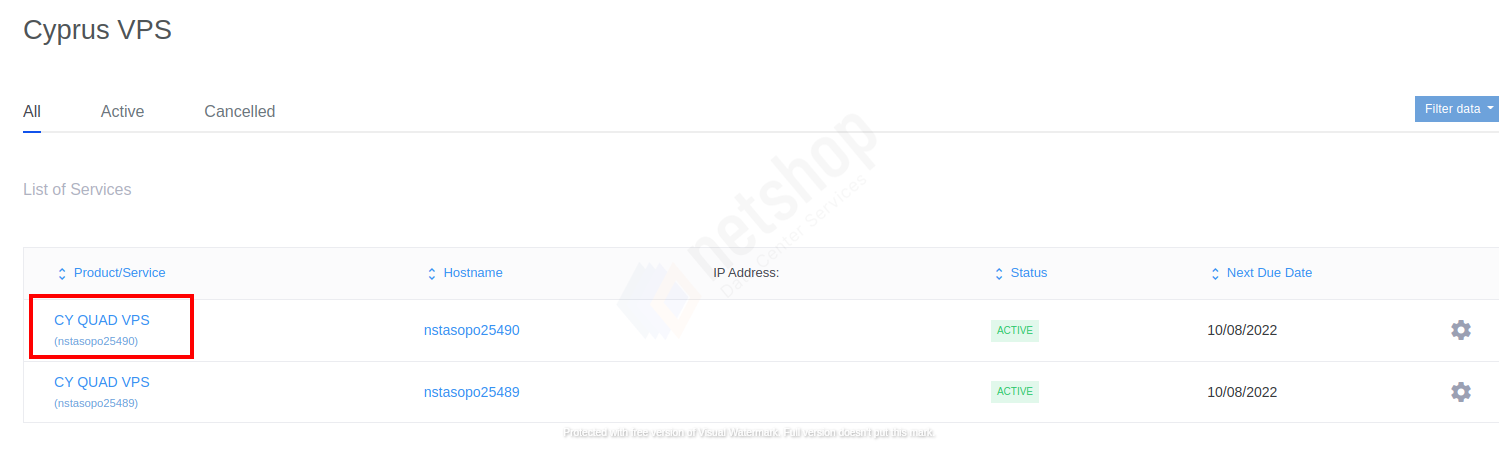
Click the Service you wish to manage
Step 3 – Connect via Web Console
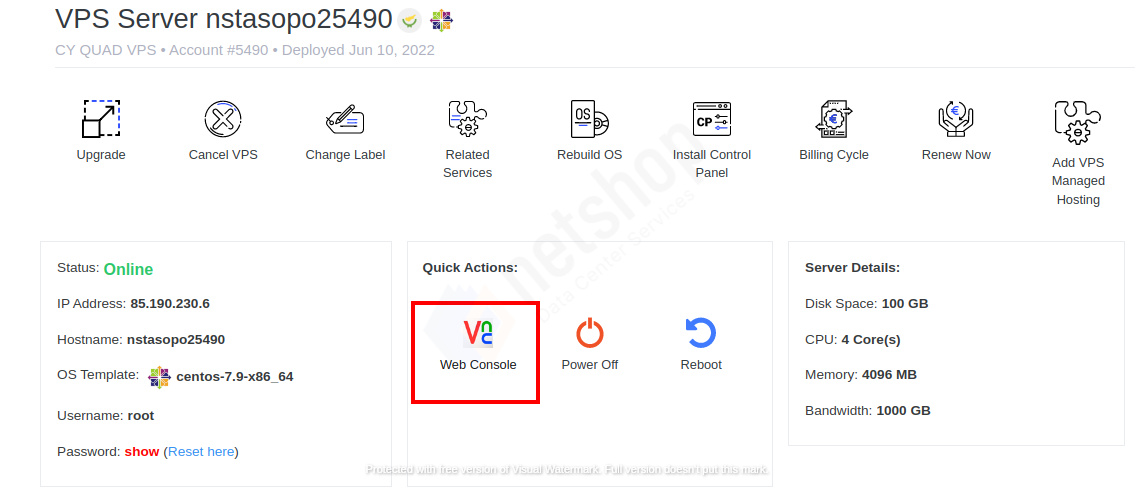
Click on the Web Console (noVNC).
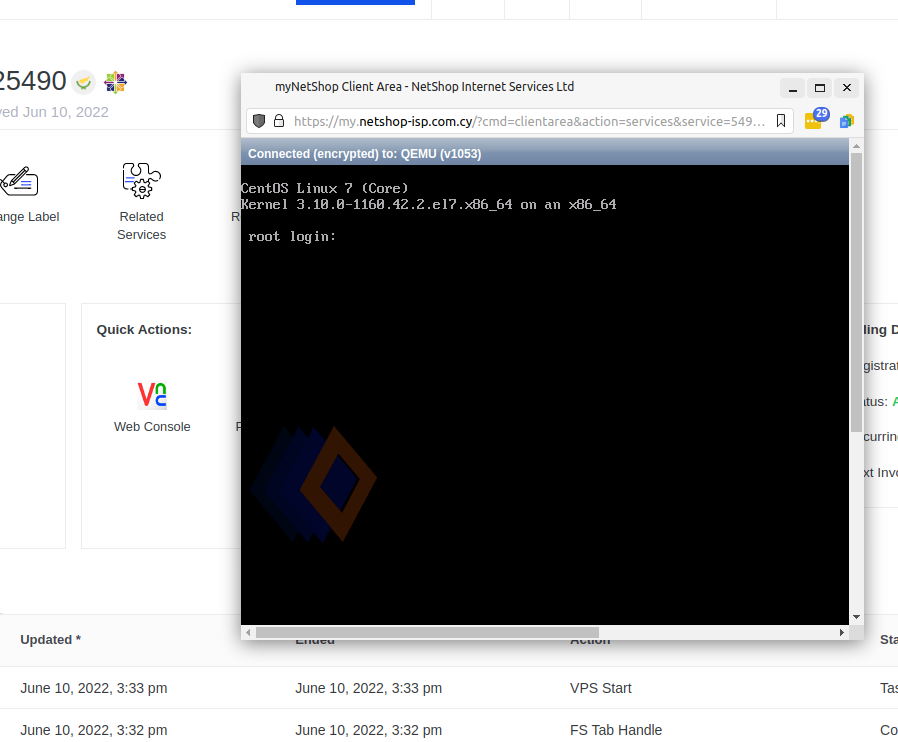
A new window will open with connection to your server. Enter your server’s login credentials and you are ready to go!
Should you get a blank/white screen on the Console window, please clear your browser’s cache and retry. If the problem persists please submit a ticket to our Support team.
How To Connect to a Linux Server from Mac
In this tutorial we will explain the easiest way to connect to your Linux VPS or Dedicated server from your Mac.
Prerequisites:
PC or laptop with MacOS.
Terminal (comes pre-installed with MacOS)
Internet Access
Active Linux VPS or Linux Dedicated Server
Your server’s IP address, Username and Password (can be found from within the myNetShop portal)
Step 1 – Run Terminal
Click the Spotlight icon. It’s the magnifying glass in the upper-right corner of the screen. See below screenshot for reference.
Type terminal in the search field. Then double click the result to open the terminal.
Step 2 – Connect via SSH
A new window with the terminal app will open.
Enter the command: ssh root@your-server-IP-address
Then provide your password and hit Enter.
On your first login attempt the system will ask if you are sure you want to connect. Type yes and hit Enter.
Congratulations! You are now connected to your Linux server via Terminal on Mac.
How To Connect to a Linux Server with PuTTy from Windows 10/11
In this tutorial we will explain the easiest way to connect to your Linux server from a Windows 10/11 workstation.
Your server’s IP address, Username and Password (can be found from within the myNetShop portal)
Step 1 – Run Putty
Click on the search bar at the left bottom of your Windows 10/11 screen and type Putty as shown below. Click on the Putty icon to launch the software.
Step 2 – Connect via SSH
Host Name (or IP Address): Enter your server’s IP Address Port: 22 (Default) Connection type: Click SSH
Then click the Open button as shown below.
Congratulations! You are now connected on your Linux server from Windows via PuTTY (SSH).
How To Connect to a Linux Server from Linux Ubuntu
In this tutorial we will explain the easiest way to connect to your Linux server from a Linux laptop/PC in two easy steps.
In this tutorial we will explain the easiest way to connect to a Linux server from your Linux laptop/PC. For the purposes of this tutorial we have used a laptop running on Ubuntu 20.04 with Gnome. The steps should work with almost all Linux distributions on Gnome or any other GUI.
Prerequisites:
PC or Laptop with Ubuntu 20.4 (or any other similar linux distribution with GUI).
Your server’s IP address, Username and Password (can be found from within the myNetShop portal)
Step 1 – Open Terminal
If you have CLI Linux proceed in step 2. If you have GUI Linux Open the terminal.
You can find the terminal on the launch bar or Click on the Show Applications in the left bottom and search for ‘terminal’ and click it as shown below.
Step 2 – Connect via SSH
A new window with the terminal application will open. Write the command:
ssh root@your-server-IP-address
Enter your server’s password once prompted and hit Enter.
For the first login attempt the system will ask if you are sure you want to connect. Type yes and hit Enter.
Congratulations! You are now connected to your Linux server via SSH.
Liquidity Bridge Hosting: The Key for a Reliable Forex Trading Infrastructure
In this article, we’ll take a closer look at why a Forex liquidity bridge is important, and what to consider when choosing a data center for liquidity bridge hosting.
When making trading decisions, liquidity is a key consideration for investors. Liquidity is used to measure the level of activity that takes place in the financial market, which is especially important when trading different currencies as it indicates a pair’s, like EUR/USD, ability to be traded without having a significant impact on its exchange rate.
With that being said, a liquidity bridge has become a fundamental component in bridging trading platforms, like MT4, MT5 or cTrader, with liquidity providers, and thus an essential tool for Brokers. In this article, we’ll take a closer look at why a liquidity bridge is important, and what to consider when choosing a data center for liquidity bridge hosting.
What is a Liquidity Bridge
A liquidity bridge, or simply ‘bridge’, is essentially software that acts as the intermediary between a trading platform and liquidity providers. Utilizing a liquidity bridge has become crucial for brokers as not only does it offer direct market access, but also faster trade execution, reduced slippage and enhanced security.
Why a Liquidity Bridge is Important to Retail and Institutional Forex Brokers
Liquidity bridges have become the industry standard for both retail and institutional Forex Brokers. By forming the bridge between the trading platform and the liquidity providers on the other end, brokers are assured that each trade is correctly pushed and cleared before reporting back to the trading platform.
One of the main features of a liquidity bridge is that it provides the ability to set pricing markups, ultimately expanding the options and customization capabilities a broker has when making a product offering. A liquidity bridge also enables brokers to buy and sell assets as close to the market price as possible by providing a single point of connectivity to multiple liquidity sources through an aggregated price feed.
Bridge software also provides tools to improve a broker’s risk-management system by giving them the ability to route orders, as well as diverse exposure and advanced reporting. Ultimately, by implementing bridge technology, brokers can effectively streamline their work, resulting in higher profits.
Key Points to Consider when Choosing a Data Center for Liquidity Bridge Hosting
As an integral part of your trading infrastructure, finding the right data center for liquidity bridge hosting is paramount, so it’s crucial to consider the following:
Location & Latency
The unwavering stability and performance of a liquidity bridge is elementary to the seamless execution of trades, and the location of your data center is the key to achieving that. Opting for a data center in a strategic financial location offers an optimal environment for attaining the ultra-low latency required for a high-quality connection.
Most of the Liquidity Providers are hosted in London and New York Data centers. Contact us for pricing information and latency results.
Security
Your chosen data center should be located somewhere safe and at low risk of natural disasters, whilst also featuring the highest standards of redundancy. Be sure to check that the data center you choose is fully certified and compliant with regulatory requirements. Finally, a data center or hosting provider that can protect your infrastructure from DDoS attacks is a big plus too.
Support
Having around-the-clock support should also be a priority when choosing a data center. It’s important to note that the integration process of a liquidity bridge could sometimes require additional support, and having a responsive team to assist you could prove extremely valuable.
List of the Best Liquidity Bridge Providers
With years of experience in the financial market, NetShop ISP has gained huge industry insight through the analysis of customer statistics that were used to compile this list of popular liquidity bridge providers.
In this article we will take a look at the 5 most popular open source web servers in 2022.
2022 marks 31 years since the first ever web server went online back in 1991. Today, there are many different types of servers, built for specific purposes and technologies. In fact, according to W3Techs, 80% of websites and web applications are powered by open source web servers, so in this article we’re going to break down the best five.
Open Source Web Server Stats 2022
What is a web server
Simply put, a web server is the system used to deliver web pages over the internet, ensuring a smooth and secure connection between the server and client using HTTP. Effectively, the server hosting the website will receive a request from the client, finds the webpage from its directory and sends it to the client’s browser.
An open source web server means that the software’s original code is public-domain and can be viewed, copied and edited depending on the terms of its license. So let’s take a look at the 5 most popular open source web servers.
Best open source web servers
Apache HTTP Server
Apache HTTP, otherwise referred to simply as Apache or httpd, is one of the most well-known web servers. Since its release in 1995, Apache has steadily risen in popularity, powering a huge majority of all websites. Although most commonly run on Linux infrastructure, it’s also available on other popular operating systems like Windows and Mac OS X.
Written in C programming language, Apache web servers are fast, reliable and generally easily customizable environments. Its modular architecture allows for additional modules to be added in order to extend its functionality, like mod_proxy to allow for a proxy on the server or mod_ssl for SSL encryption support – amongst many others.
NGINX
NGINX, pronounced Engine-X, was publicly released in 2004 as an answer to the C10K problem, which effectively means it can handle ten thousand concurrent connections and clients. In fact, the high-performance web server has recently overtaken Apache HTTP for the first in terms of usage, according to W3Techs.
In order to handle a huge number of concurrent sessions, NGINX uses an asynchronous event-driven architecture. Its easy scalability and efficiency in terms of resource utilization is what has made the web server so popular, especially for hosting high-traffic websites.
Apache Tomcat
Unlike Apache HTTP and NGINX, Apache Tomcat is not necessarily an ordinary web server but rather a Java servlet which extends the functionalities of the server. Apache Tomcat also implements technical specifications of the Java platform, ultimately making it an optimal environment for running Java applications.
Node.js
Used for building web applications in Javascript, Node.js is first and foremost a server-side runtime environment with an HTTP module to extend its functionality to that of a web server. Although it powers a relatively small amount of websites, Node.js has generated a lot of attention, especially in terms of hosting real-time web applications.
Lighttpd
Known for being highly economical with regards to resources like CPU, and its low memory requirement, Lighttpd is optimized for efficiency. Being built on the asynchronous request handling model is what makes it the ideal solution for hosting high-performance web applications. Although oftentimes compared to NGINX, Lighttpd has continued to grow in popularity due to its simplicity and speed optimization.
Choose the right Web Server with NetShop ISP
Need help deciding the best web server or hosting solution for your needs? Get expert advice from our team to guarantee your website runs efficiently.
NetShop ISP is an award-winning Hosting Provider with privately-owned Infrastructure in Cyprus, Malta, United Kingdom, The Netherlands, Singapore, United States and Hong Kong.